Friday, 4 October 2013

Funny weather upsets our invasive plants & stem injecting knotweed

We had some late frosts this year and an almost unheard of very prolonged and hot summer. This meant that our dominant invasive friend, Himalayan balsam, came out to play later than usual and really struggled in the heat, wilting pathetically in July. Sadly, the inevitable rains came down and the balsam went up. Furthermore, the long mildish late Autumn with good spells of sunshine and rain has brought up an abundance of small Himalayan balsam. Speaking to a colleague in Cardiff this was also happening in Cardiff in late August. After a walkabout on our Nature Reserve late on this evening I was amazed to see more little balsam plants out in flower on the second of October. The common mantra is don't pull or cut late in the season (very late August or early September) here I was pulling it up happy in the knowledge that there were no ready seed pods. Even some left over bigger plants had seed pods yielding with much effort white, unripe seeds. So I imagine those people who have given up for the year are advised to take one last look especially along or near waterways and pull them up.

7 inch high Himalayan balsam in flower Oct 2nd.
We have 1 Japanese knotweed stand as well which has been treated by Torfaen Council Ranger Jon Howells and volunteers for the past 3 years. It is now a small stand of only 15 or so stems. The summer heat and dry soil has almost killed the plant with leaves for much of the year being yellowish rather than a vibrant green. However, the sudden wetness with sunshine has brought parts of the plant back to life with little green leaves emerging in October. On a few stems the plant has just come into flower almost a month after most over plants found abundantly throughout Torfaen.
OUR SICKLY LOOKING KNOTWEED STAND (UNTREATED APART FROM A GOOD DROUGHT)
Some small green leaves coming through with small flower bracts
One stem with no leaves and flowers emerging
The plan on Friday morning is to treat the Japanese knotweed with herbicide (glyphosate) with a technique called stem injection. Japanese knotweed stems resemble bamboo with hollow stems. The stem injector has a needle with the hole not at the end like a drug needle, but part the way along.
The hole of the needle is on the side to help prevent blockages and safe infusion into the hollow stem
This means when you put it into the stem it doesn't get blocked and when you depress the syringe trigger it empties into the stem. For Japanese knotweed the best way of doing this is just below the 3rd node above ground level. The plant then takes the glyphosate down into the rhizomes where it starts to kill the plant. The best time of the year to do this is when the plants are at terminal height and when the plant is in flower. Like we discussed earlier, you have to go off the plant not a set date in the calendar and this year for this clump it is very late. This stand was much bigger in previous years and it has been sprayed in the past. This is the usual method for large stands, but you need to be much more careful with weather conditions i.e. not very windy and dry. You are also much more likely to get some drift onto nearby plants which may kill them too. This isn't always a terrible thing as you need to get close to the plants to be able to treat them. With Stem injections the weather is less of an influence, it just takes a lot longer as each stem is injected. Furthermore, you normally spray with a 3-4% glyphosate solution, stem injections are normally 1 ml of neat or 2ml of 50% strength glyphosate so is a much less efficient way of introducing glyphosate into the plant.
Stem injecting a small knotweed stem, Fri 4th Oct 2013
Importantly, when using herbicides you still need the right training, or to be working with someone who is properly trained if you are working on public or someone else's land (PA1, PA6 and if near water PA6W). As the LNR is publicly owned, permission was granted from Torfaen County Borough Council (TCBC) to do this. We are using a little of TCBC's glyphosate for the treatment and one of Keep Wales Tidy's stem injector kits; a nice example of partnership working. There are many volunteer groups across Wales who are now supporting local authorities to tackle invasive species which has to be a better way of tackling these especially in these difficult economic times and we are proud to be doing our part in this.


Tuesday, 17 September 2013

Tidy Wales Week Success and in the papers

Last night saw 5 volunteers pull out 10 bags of litter from Henllys Local Nature Reserve. The pick was part of Keep Wales Tidy's nationwide Tidy Wales Week campaign. Most of the litter was collected from the areas recently flailed by the tractor on the reserve and was mainly found near the hedgeline bordering Henllys Way (i.e. chucked over the hedge). The litterpick lasted around 1.5 hrs and included a mini-tour of the reserve to the 2 newcomers.


Litter along the hedgeline before and after
We dragged all the bags to the other end of the reserve at the car park where TCBC's Street Scene team kindly removed this the next day.

Roller blinds
Chris Partridge from Friends of Henllys LNR said "It is always a good feeling to rid a beautiful site like ours of litter and we are pleased to take part in a much larger project with many other like-minded people across Wales for Tidy Wales Week".

Cllr. Smith-Higgins added "We should consider ourselves very fortunate indeed to have a nature reserve on our doorstep here in Henllys, and extremely lucky to have a group of people who freely give their time to keep it in good order. I was delighted to be able to make a small contribution in time to help out and I would urge others to spare some time as well...litter picking can be quite therapeutic!"


View Tidy WalesWeek Litterpick in a larger map

The team with haul
More pictures from the event can be viewed here: http://flic.kr/s/aHsjJh48RA

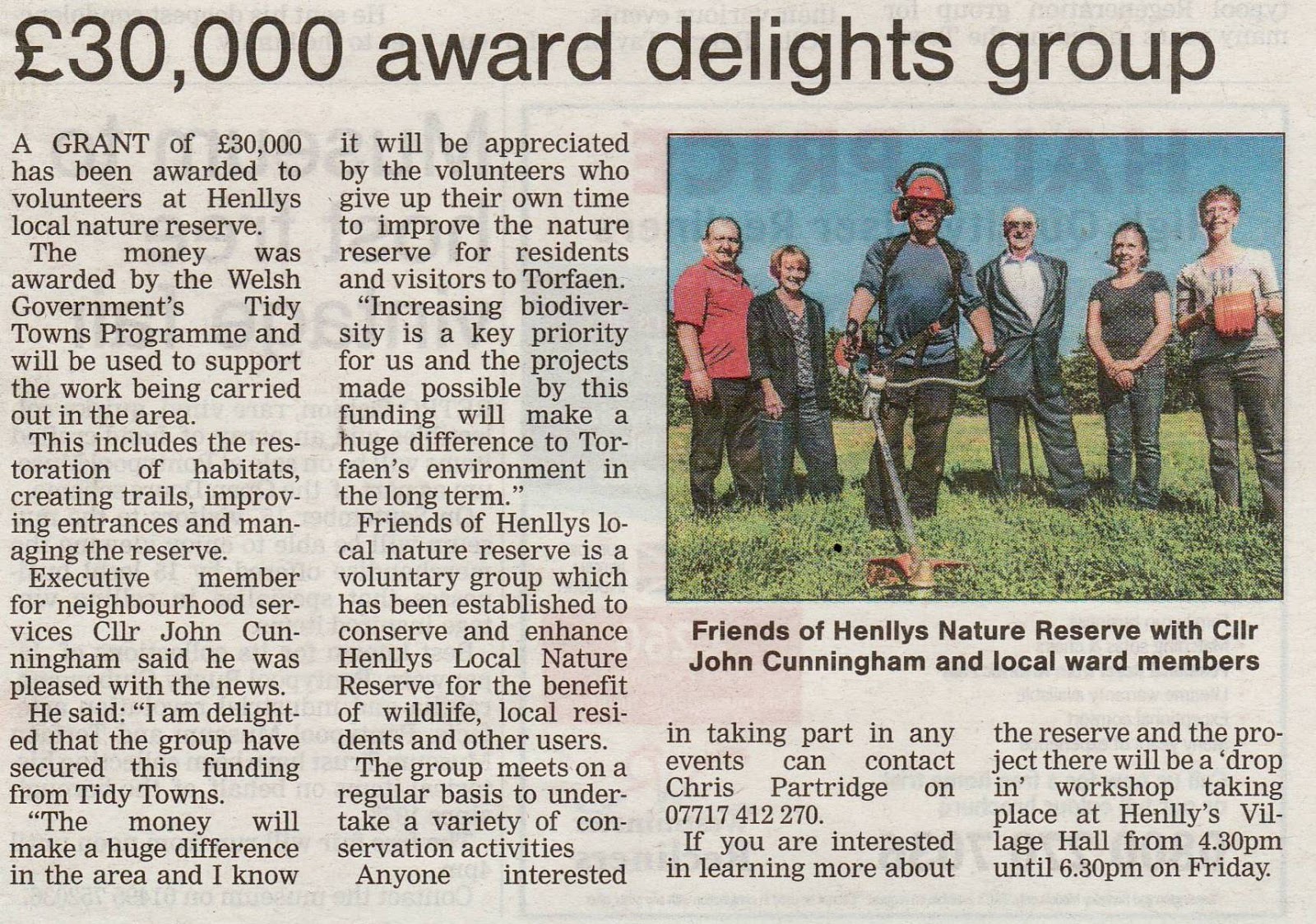
We were joined by local Henllys Community Council's Cllr. Lawrence Smith-Higgins and a new volunteer Brian. Both came along to the last Friday's consulation on the Welsh Govenment funded Local Authority led Tidy Towns Grant that was recently awarded to the Local Nature Reserve. Their first taste of the grant was wearing a pair of gripper gloves. Previous to this, we all brought our own gloves to events, so this is a great start again for the group. Below shows this week's article in the Pontypool Free Press (please note the telephone number is 07824504813 for getting in touch).

Pontypool Free Press Article (Wed 11th Aug)

Thursday, 12 September 2013

Tidy Wales Week tidy up September 16th at 6pm.

We will be taking part in Keep Wales Tidy's nationwide Tidy Wales Week campaign on Mon Sept 16th at 6pm http://www.keepwalestidy.org/tidy-towns/tidywalesweek.

Date: 16th Sept
Time: 6pm
Meet: Car Park off Birch Grove (NP44 6EP)

We'll mainly be clearing some of the rubbish exposed after the recent Welsh Government Tidy Towns Funded opening of the LNR by the tractor flail and bruchcutters. All equipment will be provided. Wear suitable clothing for the weather and ground conditions which may be wet, slippery and uneven. For any more information contact the Friends via friendsofhenlyslnr@gmail.com or 07824504213.

Rubbish exposed after tractor flailing

Wednesday, 4 September 2013

Final group balsam event

Date: Mon 9th September
Time: 6pm
Location: Meet Car Park off Birch Grove NP44 6EP
Bring: sensible footwear and gardening gloves if you have them.

With the start of school, it is a good chance to get rid of some excess excitement by helping to pull up more Himalayan balsam for perhaps the last time for this year. With help from 1st Henllys Scouts, a massive area mown by tractor as part of the new Tidy Towns funded project and the group and others usual hard work, we have pulled an amazing amount this year, but there is always loads more to do. You are all invited to come along and join in a little bit more in this final push for the LNR.

As Churchill may have put it:

"We shall go on to the end. We shall fight in the football field, we shall fight behind Glan Rhyd and orchard, we shall fight with growing confidence and growing strength with care, we shall defend our LNR, whatever the cost may be. We shall fight on the beaches, we shall fight on the flood plains, we shall fight in the fields and in the streams, we shall fight in the drain grills; we shall never surrender"

Contact Chris on 07824504813 or friendsofhenllyslnr@gmail.com for more details or if you are planning on joining us.


View Henllys LNR in a larger map

Tel 07824504813
Email: friendsofhenllyslnr@gmail.com
Twitter: @HenllysLNR

Sunday, 1 September 2013

Time is of the essence of balsam

Himalayan balsam is a remarkable plant. During the hot spell earlier in the summer, acres of this plant were wilting almost to the point of saving us from having to treat it, However, and inevitably, the rains did come and the plants have not just bolted, but bolted into flower too. This puts us into the difficult management period of Himalayan balsam control. There is no rule of thumb here, we pull until there is more green than pink. That is when the pink flowers have turned to seed pods. When these pods are young and small, the seeds inside are white small and not viable.

Later on these pods swell, the pods ripen to a black hard shell and them they explode sending the seeds over 5m away. Pulling balsam by hand into massive piles appears to be a great method of control, if you have a load of people. We are now at the point where smashing them down will do less harm than good.....unless we have an Indian summer. Last year, Himalayan balsam plants were still in flower in October, when adjacent plants had already shed all of their seeds. A plant with a smashed stem, this late in the normal season may have time to regrow new flower heads from any left over node, if the weather is on the plant's side.

Some signs of larger green seed pods. The seeds inside were mainly white with some small brown patches
We have started now doing mixtures of pulling by hand and blitzing with a new Tidy Towns funded brushcutter.
Nicola and Tricia out on a Balsam pull
balsam in bramble

balsam with minimum bramble clearance, brushcutter then pull by hand
What we really need is a small army of people to get down as much balsam as possible in the last couple of weeks. This could be tricky and also unlikely, the schools start up again this coming week, so they'll be really busy and the transition is a tough time for the scouts. Still, we can't complain as we have achieved so much this year compared to previous years and it has all been down to forging new partnerships.